


Hospital bag checklist
0 of 8 packed
You’re all set
Having trouble connecting — tap to retry.
Real-time, shared with everyone who loves them — from pregnancy through the first years.
We’ll email a one-tap sign-in code. No password.
A working reference for the people who love and care for a new baby. Built for parents, grandparents, and caregivers.
Every caregiver logs from their own phone. Everyone sees the same picture in seconds.
One tap for the common case. iOS Shortcuts let you say “Hey Siri, log feed.”
Start in pregnancy with gestational age, kicks, contractions. Transition cleanly to a baby record at birth.
WHO growth-curve percentiles, vaccination schedule, developmental milestone tracking.
Row-level database security means your data is yours alone. Invite-only collaborators.
Add to Home Screen on iPhone or Android. Works offline. No app store required.
We’ll email a one-tap sign-in code. No password.
A warm, evidence-based companion for the months ahead — tracking how {{first_name}} is growing, what’s coming next at the OB, and how you’re feeling along the way.
Add your due date in Settings to see this week’s milestones.
Your visit schedule will appear here once your due date is set.
Kick counts typically begin around 28 weeks. You can start anytime — tap the Kick Counter tab to log a session.
Tap below to record the birth. We’ll switch this guide over to postnatal content immediately — sleep, feeding, vaccinations, and growth.
Drag the scrubber or tap a week to see what’s developing. Anchored on your current week.
—
—
Aligned with ACOG’s 2025 tailored prenatal care guidance for average-risk pregnancies. Mark each visit complete as it happens.
A quiet place to log how you’re feeling. Nothing is required — track what helps you.
No entries yet. Logging anything — even just once — will start a quiet pattern view here.
Track fetal movement and time contractions when they arrive. ACOG recommends timing how long it takes to feel 10 movements — ideally within 2 hours, starting at 28 weeks.
Tap each time you feel a kick or distinct movement. Sessions end automatically after 60 min of no taps.
Tap to start when a contraction begins, tap again when it eases. The app records duration, interval, and optional intensity, and watches for the 5-1-1 threshold.
Source: Baylor Scott & White — Braxton Hicks vs. real contractions (5-1-1 rule)
Practical, evidence-based guides for the home stretch and beyond.
Early labor: contractions become regular, cervix dilates to 6 cm. This stage is usually the longest. Rest, hydrate, walk if comfortable.
Active labor: contractions strengthen, cervix dilates 6–10 cm. Head to the hospital. Continuous support and position changes help.
Pushing & delivery: cervix fully dilated; you’ll feel the urge to push. Average duration 30 minutes to 3 hours for a first baby.
Placenta delivery: 5–30 minutes after birth. Skin-to-skin and early breastfeeding can begin during this stage.
A working guide to caring for {{first_name}} — {{pronoun_poss}} feeding, sleep, airway, vaccinations, and how {{pronoun_subj}}’s growing. Written in plain language for the people who love {{pronoun_obj}}, used day-to-day by the people who care for {{pronoun_obj}}.
A live snapshot of {{pronoun_poss}} age, recent measurements, and what’s next. Tap any card for the full picture.
Why {{first_name}} cries inconsolably at dusk — PURPLE crying, the brain science of {{pronoun_poss}} still-developing internal clock, and a timeline of when it eases. Written for grandparents and family.
Read the explainer →A one-page family reference: what to do, what to avoid, why room-sharing matters, and the simple things that keep {{first_name}} safest while {{pronoun_subj}} sleeps.
Open the card →If you've watched {{first_name}} sputter, gulp, or grunt on {{pronoun_poss}} own saliva when {{pronoun_subj}}'s lying on {{pronoun_poss}} back — this section explains what you're seeing, why it happens, and what to do. Written for the family who watches {{pronoun_obj}} sleep.
Read the explainer →{{first_name_possessive}} feeding journey from birth through {{pronoun_poss}} first birthday — the milk-only months, paced bottle-feeding for expressed breast milk, and what comes next. A live progression marker shows where {{pronoun_subj}} is right now.
Open the guide →Four evidence-based pillars for keeping food and environmental allergies from taking hold — daily skin care, early sustained allergen introduction, breastfeeding and diet diversity, and a microbiome-friendly home. Plus a synced 9-allergen introduction tracker.
Open the guide →{{first_name_possessive}} immunization schedule from birth through 18 months, following the 2026 AAP recommendations. Tap each dose to mark it done — the chart updates with {{pronoun_poss}} real-time age and shows what’s upcoming, complete, or overdue.
Open the tracker →Plot {{first_name_possessive}} weight, length, and head circumference against the WHO growth standards, and tick off the developmental milestones {{pronoun_subj}}’s reached. The chart and checklist follow {{pronoun_poss}} real-time age.
Open the chart →What {{first_name}} is ready for now — from neighborhood walks to public pools, plane trips, restaurants, and concerts. A live timeline shows what’s unlocked at {{pronoun_poss}} current age, and you can tap to record {{pronoun_poss}} firsts as a shared keepsake.
See what’s unlocked →This site is a way to share what we're learning about Usha's care with the family who loves her.A living reference to share with the family who loves your baby — what you're learning, what you're tracking, what comes next. Everything here is written by us, for us, and informed by pediatric and circadian-neuroscience literature. It is not a substitute for her pediatrician — it's the context behind the things we say and do.
Usha Harrykissoon · Born March 12, 2026For your growing family.
Every evening, {{first_name}} cries inconsolably at dusk. It looks distressing, but it's a well-described, temporary, and completely normal phase of newborn development. Here's the science behind it — and why it will resolve on its own.
This is one of the most common and well-documented patterns in healthy newborns.
What {{first_name}} experiences each evening has two names in the medical literature. Pediatricians call it the "witching hour" — a colloquial term for the nightly window of inconsolable fussiness that occurs around dusk. Researchers call it PURPLE Crying, an acronym developed by the National Center on Shaken Baby Syndrome to help parents understand this normal developmental phase:
Usha's pediatrician has confirmed this is the witching hour — a well-known, normal phenomenon. She is healthy, growing, and developing perfectly. The crying looks alarming, but it is a sign of a brain that is actively maturing, not a sign of distress or an unmet need.
If a pediatrician has examined your baby and ruled out medical causes, the witching hour is a well-known, normal phenomenon. The crying looks alarming, but it is a sign of a brain that is actively maturing — not a sign of distress or an unmet need. If you have not yet checked in with your pediatrician, do so before assuming the cause.
A tiny structure in the brain called the SCN controls our internal clock. In newborns, it's not ready yet.
Deep inside the brain, just above where the optic nerves cross, sits a tiny cluster of about 20,000 neurons called the suprachiasmatic nucleus (SCN). This is the body's master clock. It tells us when to feel sleepy, when to wake, and how to transition smoothly from day to night.
In adults, the SCN orchestrates the release of melatonin (the sleep hormone) at dusk and cortisol (the wake-up hormone) at dawn. This gives us a smooth, predictable daily rhythm.
In newborns like {{first_name}}, the SCN is anatomically present but functionally immature. It exists, but it hasn't learned to keep time yet. Without a working clock, her brain cannot manage the transition from day to night smoothly — and dusk becomes a vulnerable window of dysregulation.
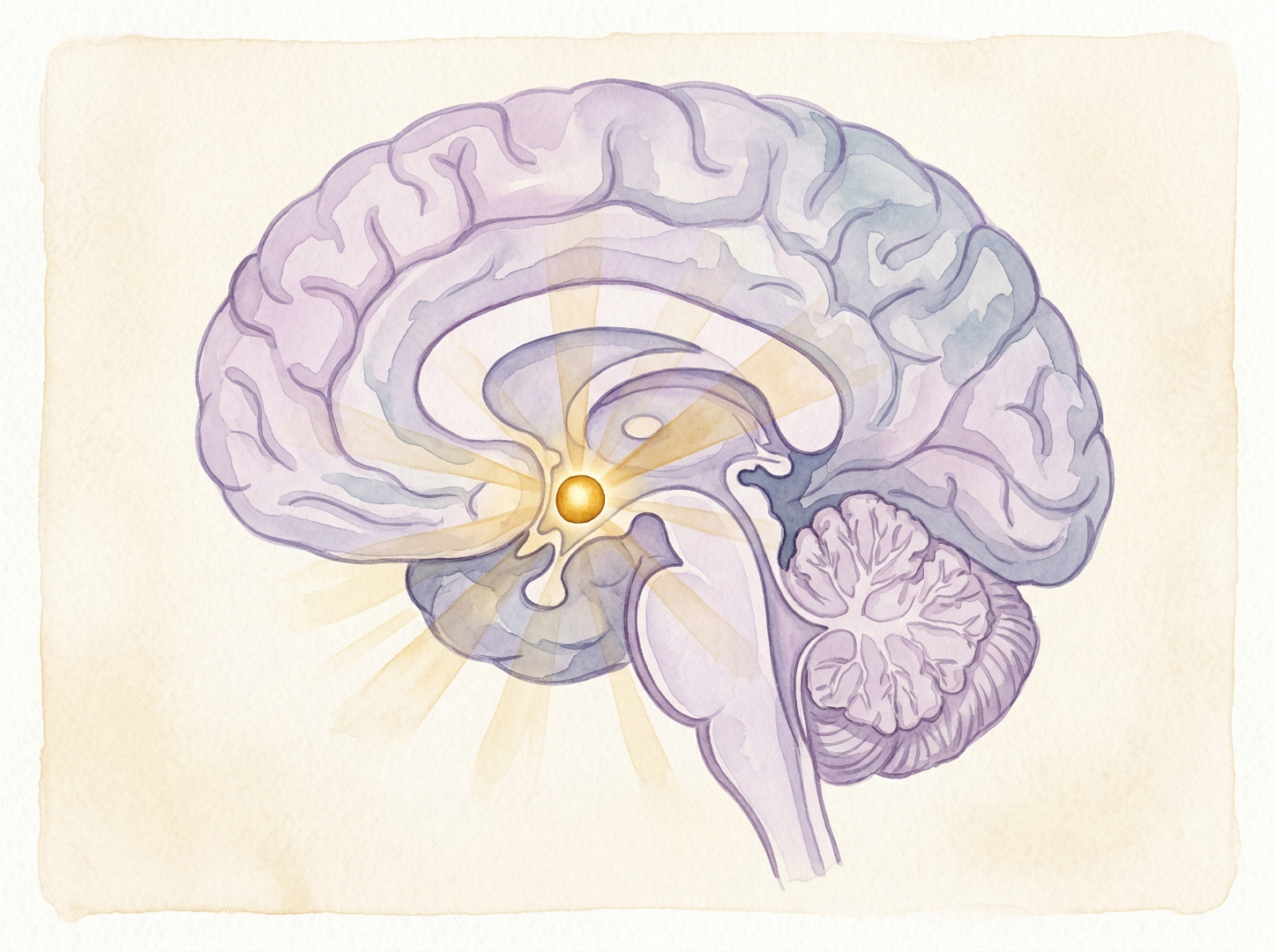
Newborns don't yet produce their own melatonin — that doesn't begin until around 3 months. Without this internal signal, {{first_name_possessive}} brain has no chemical cue to differentiate dusk from any other time of day. The falling light creates a mismatch between external cues and {{pronoun_poss}} immature internal clock, resulting in a window of fussiness and dysregulation. This is temporary and resolves as {{pronoun_poss}} SCN matures.
Interestingly, this same brain clock explains "sundowning" in the elderly — and the parallel is remarkably reassuring.
You may have heard of sundowning — when elderly individuals with dementia become agitated, confused, and restless specifically at dusk. The mechanism is strikingly similar: in those patients, the SCN has deteriorated through age-related cell loss and plaque formation. In {{first_name}}, the SCN hasn't matured yet. Same clock, opposite bookends of life.
Unlike sundowning in the elderly, which results from irreversible neurodegeneration, {{first_name_possessive}} evening fussiness comes from an SCN that is actively developing. {{Cap_first_name}}'s internal clock is building itself right now. Once melatonin production begins (~3 months) and cortisol rhythms establish, the dusk transition will smooth out naturally. This resolves on its own without any intervention.
The witching hour follows a predictable arc. Knowing the timeline helps.
Based on Brazelton/Barr research — it gets better.
Brazelton (1962), Barr (1990) — average hours of crying per day across healthy infants.
All these systems mature over the first 4 months.
Circadian maturation milestones from pediatric sleep medicine literature.
The pattern typically emerges as the nervous system begins processing daytime stimulation but cannot yet self-regulate at dusk.
This is the most intense period. Crying may be longer and harder to manage. This is completely normal and expected. It is the turning point — after this, things begin to improve.
The SCN starts establishing recognizable day–night patterns. You may notice {{first_name_possessive}} sleep becoming slightly more predictable, with longer stretches at night.
{{Cap_first_name}} will begin producing {{pronoun_poss}} own melatonin, and {{pronoun_poss}} cortisol rhythm will establish. The dusk transition smooths out. Evening fussiness resolves. This coincides almost exactly with the end of the "fourth trimester."
By this point, the witching hour is typically a memory. {{Cap_first_name}} will have a functioning circadian system, predictable sleep–wake cycles, and smooth day-to-night transitions.
Usha is approximately 6 weeks and 2 days old (born March 12, 2026). She is at the peak of the witching hour pattern right now. This is the most intense period — but it is also the turning point. From here, her SCN is maturing rapidly, and the evenings will begin to ease.
{{Cap_first_name}} is —. During the peak window (around 6–8 weeks), the witching hour pattern is most intense — but this is also the turning point. From here, the circadian system matures rapidly, and the evenings begin to ease.
Two complementary frameworks help caregivers respond well — the acoustic-spectrum view from peer-reviewed cry research, and Dunstan Baby Language (DBL), a heuristic for the brief pre-cry sounds that signal what's coming.
Acoustic studies (ChatterBaby, Pediatric Research 2019) found cries fall along this spectrum. Notably, colic cries are acoustically indistinguishable from pain cries in pitch — purple-crying behaves like a pain-state cry even though it is developmentally normal.
These are reflexive sounds babies make in the brief window before a full cry escalates. Catching them early lets caregivers respond before escalation. Independent reviews report 89–94% recognition accuracy after training.
"I'm hungry"
Usha: her "eeh-eeh" with rooting fits this — likely a softened Neh.
Listen for: rooting plus "eeh-eeh" or a soft "Neh" — both signal hunger in young babies.
"I'm tired"
Wind-down cue: 60–90 min after last sleep, start the routine.
Hot, cold, wet, itchy
Check first: diaper, room temp, swaddle tightness, seams.
Upper gas — needs to burp
Try: upright hold + back pats for 60–90 seconds.
Tummy / lower gas pressure
Usha: the "laaar-laaar" during purple crying tracks here — sustained voiced /a/ under abdominal tension. Bicycle legs, warm tummy, paced soothing.
Listen for: a sustained "laaar-laaar" with a tight belly often tracks here — try bicycle legs, a warm tummy, and paced soothing.
Engagement / mild boredom
Usha: her "eeh-eeh" without rooting fits this — earliest social-communication channel, age-appropriate.
Listen for: "eeh-eeh" without rooting often shows up here — the earliest social-communication channel, age-appropriate.
Acoustic research is consistent: a sudden upward pitch shift with sustained intensity that resists usual soothing is the most reliable signal a cry is pain-driven, not fussiness. Quick checks: hair tourniquet on fingers/toes, corneal abrasion (eyelash), hernia exam, temperature, recent feeds, and any new onset outside the typical late-afternoon window.
Reading about phonemes only goes so far — the sounds are easier to recognize once you've heard them in context. These two clips work together: the first walks through each DBL sound with what to listen for; the second covers the broader cry-type taxonomy with real baby footage, including pain and boredom signals.
Sources: Parga JJ et al., Defining and distinguishing infant behavioral states using acoustic cry analysis, Pediatric Research (2019); Dunstan Baby Language; Healthline DBL overview; Cleveland Clinic — Purple Crying.
No. Although the crying looks like a pain reaction, the medical literature is clear that PURPLE crying is not caused by pain or illness. Usha's pediatrician has examined her and confirmed she is healthy. The "pain-like" face is part of how a developing nervous system expresses dysregulation — not a signal of harm.No. Although the crying looks like a pain reaction, the medical literature is clear that PURPLE crying is not caused by pain or illness. If a pediatrician has confirmed your baby is healthy, the "pain-like" face is part of how a developing nervous system expresses dysregulation — not a signal of harm.
No. The witching hour appears in well-fed, well-loved, well-cared-for babies across cultures. It is a developmental phase, not a parenting problem. Trying many things and "nothing working" is part of the textbook description.
She is already followed by her pediatrician, who has confirmed this is the witching hour. We watch for genuinely worrying signs — fever, poor feeding, unusual lethargy, breathing changes, or sudden change in pattern — and we'll seek care immediately if any appear. Crying alone is not a worrying sign at this age.
Yes — gentle, low-stimulation soothing helps: dim lights, calm voice, swaddle if she likes it, motion (rocking, walking, baby carrier), white noise, pacifier, skin-to-skin. None of these always work, and that's expected. The goal is to ride it out together, not to "fix" it.
For most babies, the intensity peaks around 6–8 weeks and noticeably eases by 3 months, fully resolving by 3–4 months. Usha is right at the peak now.For most babies, the intensity peaks around 6–8 weeks and noticeably eases by 3 months, fully resolving by 3–4 months.
No. The witching hour and later sleep patterns are unrelated. Babies who have intense witching-hour periods do not have worse sleep as toddlers or older children.
Every evening that feels hard right now is {{first_name_possessive}} circadian system building itself. The same clock that causes this temporary fussiness will soon give {{pronoun_obj}} — and your whole family — peaceful, predictable nights.
If you’ve watched {{first_name}} lie on {{pronoun_poss}} back and suddenly grunt, gulp, or briefly hold {{pronoun_poss}} breath — then cry and recover — you’ve witnessed something that looks frightening but is normal and protective. This page explains what you’re seeing, why it happens, and what to do.
If you’ve seen one of these, you know they can be alarming. Here’s how to recognize them — and what they actually are.
Watching this happen, the natural worry is: “If she’s flat on her back, won’t gravity carry that fluid into her airway?” It’s a reasonable question — the same one that led to decades of stomach-sleep advice before the 1990s. The answer turned out to be the opposite of what intuition suggests. The next two sections show why.
The reason supine is the recommended position — and the reason these episodes resolve on their own — comes down to two pieces of geometry.
Geometry adapted from NICHD/AAP educational materials and the Red Nose "Supine is Safest" diagram. Chemosensitive tissue is also denser on the posterior pharyngeal wall — closer to refluxate when supine, triggering protective reflexes earlier.
The grunting, breath-holding, and recovery you witness are her airway-protective reflexes working — not failing. Here’s the three-step sequence playing out in those few seconds.
Saliva (or a small reflux of stomach contents — the white "congealed milk") collects at the back of the throat during sleep, when swallow frequency drops.
Sensors at the entrance to the larynx detect the fluid. The vocal cords briefly close and breathing pauses — preventing anything from entering the trachea.
A swallow follows; in babies older than 1–2 months, a cough may join in. The brief breath-holding triggers an arousal — which is why she cries. The cry is the rescue, audible.
Refluxed material in the esophagus has to travel up and over the laryngeal ridge to reach the airway — a path against gravity. In prone, gravity does the opposite.
The chemosensitive tissue that triggers airway protection is densest on the back wall of the pharynx — closest to refluxate when she lies supine. The reflex fires sooner.
Babies in supine sleep more lightly and rouse more readily to breathing challenges. Prone babies arouse less, swallow less during sleep, and work harder to breathe.
What you're describing is the normal expected pattern. These signs would change that and warrant prompt evaluation:
Every gulp, grunt, and tiny startle you witness is {{first_name_possessive}} airway protecting itself — a reflex that’s been refined for millions of years and is at its sharpest right now. Watch, hold {{pronoun_obj}} if you need to, and trust the system. The red-flag list above is the only time to act differently.
A simple, one-page card you can save, print, or share. Everything here is what your pediatrician — and the American Academy of Pediatrics — recommend, written for the people who love her and help care for her.
Every nap. Every night. Every caregiver.
The risk of SIDS is highest between about 2 and 4 months. {{Cap_first_name}} is entering that window now, so the rules above matter most over the next few months.
She was born full term (38 weeks), she is a girl (girls have lower baseline risk than boys), and her household is non-smoking. These all lower her starting risk before any other choice we make.
Sharing a room with us cuts the risk roughly in half compared to sleeping alone in another room — and it avoids the much higher risk of an adult bed.
It's one of the most consistent protective findings. We don't know exactly why it works, but we know it does. If she spits it out, no need to put it back in.
If you're caring for {{first_name}} — even for a short nap — please follow the card above exactly. The biggest risks happen when a baby is placed somewhere different than usual, like a couch, an adult bed, a recliner, or in someone's arms while they fall asleep. When in doubt: back, bare crib, bassinet.
Newborns spend about half their sleep in “active” sleep — the infant equivalent of REM. Unlike adult REM, their muscles aren’t paralyzed, so they twitch, grunt, whimper, breathe irregularly, and sometimes briefly cry — all with eyes closed and still asleep. The other half is quiet sleep: still, regular breathing, and so calm it can prompt a hand on the chest. Both are normal.
Before responding bassinet-side, stop and watch for 30–60 seconds. If {{first_name}} is in active sleep, the noise and movement stay inconsistent and {{pronoun_subj}} settles on her own. If she’s truly waking, the cry escalates and her eyes open. Picking her up during active sleep often fully wakes her, disrupts the cycle, and shortens the next stretch. Doing nothing is often the right answer.
Maturation is gradual, not a switch. The marker shows where {{first_name}} is today.
Right now: newborn architecture — expect noisy active sleep, irregular breathing, and frequent transitions. Both parts of this are normal at this age.
Active-sleep noises can wake caregivers all night even when {{first_name}} doesn’t need anything. A few tactics that keep room-sharing intact while restoring rest: turn the monitor volume down so only escalating cries register, place a sound machine between the bed and the bassinet to mask grunts, and within AAP guidance, position the bassinet a little farther from the bed if every small noise reaches you.
Based on Sleep and infant development in the first year (Pediatric Research, 2026), the Encyclopedia on Early Childhood Development, and the AAP 2022 Safe Sleep guidance.
The card above prevents most risk. These are signs to act on right away, regardless of sleep:
Recommendations follow the American Academy of Pediatrics 2022 Safe Sleep guidance and the NICHD Safe to Sleep program. This card is general guidance — it is not a substitute for {{first_name_possessive}} pediatrician.
Back. Bare crib. Bassinet. Three words from everyone who loves her, every time she sleeps.
A living guide to the first twelve months of feeding. Right now {{first_name}} is taking expressed breast milk by bottle — the same milk a nursing baby would receive, just delivered a different way. This page explains where she is on the feeding journey, what comes next, and what good feeding looks like at each stage.
Five stages from birth to {{pronoun_poss}} first birthday. The marker shows where {{first_name}} is today.
Birth → 12 months · transitions are gradual and overlap.
Right now: exclusive milk feeding. Solids are still months away.
The current stage is highlighted. Transitions are gradual — no stage starts on a single day.
Breast milk (or formula) is the only nutrition {{first_name}} needs. {{Cap_first_name}}'s gut, kidneys, and oral motor skills aren’t ready for anything else. Feeds are frequent — typically every 2–3 hours, around 8–12 feeds per day — and the volume per feed grows from about 1–2 oz at birth to 3–5 oz by 4 months.
Milk is still the whole diet. Start watching for the four signs that {{first_name}} is ready for solids — usually appearing closer to 6 months than 4.
All four together — not just one — signal readiness. Starting earlier than 4 months is associated with higher allergy and obesity risk.
Milk is still {{pronoun_poss}} main calorie source. Solids are for practice — learning to move food with {{pronoun_poss}} tongue, swallow, and explore tastes. Start with single-ingredient, smooth purées: iron-fortified infant cereal, mashed avocado, sweet potato, banana.
The pincer grasp emerges. {{Cap_first_name}} can pick up small soft pieces between thumb and finger. Move from smooth purées to mashed textures, then to soft finger foods cut to safe sizes.
By {{pronoun_poss}} first birthday, {{first_name}} will be eating most of what the family eats — just cut small and seasoned lightly. This is the stage of self-feeding: spoons in fists, fingers in everything, lots of mess. The mess is the work.
Because some babies take expressed breast milk by bottle, how the bottle is offered matters as much as what’s in it.
Not flat on her back. Her head should be slightly above her hips so milk flows at her pace, not gravity’s.
Hold the bottle nearly level. Milk should fill only the tip of the nipple. This lets her draw milk by sucking, the way she would at the breast.
Use the slowest flow rate the bottle brand makes. Faster nipples force her to gulp and override her fullness cues.
Tip the bottle down briefly so milk drains from the nipple. This mirrors the natural pauses at the breast and lets her register fullness.
If she turns her head, splays her fingers, slows down, or pushes the nipple out — she’s done. A half-finished bottle is fine.
Halfway through the feed, switch which arm holds her. It mimics the side-switch at the breast and supports balanced eye and neck development.
A typical bottle empties in 5–10 minutes. A breast feed takes 15–25. Paced feeding closes that gap so {{first_name_possessive}} digestion, satiety signaling, and oral-motor development match what they would be at the breast — even though the milk arrives by bottle. It also reduces overfeeding, reflux, and the gulping that shows up later as the airway-protection episodes some babies have during sleep.
Crying is a late hunger cue. Catching the early ones makes feeds calmer for everyone.
Offer the bottle now — before crying starts.
Calm her first — rocking, skin-to-skin — then offer the bottle. A frantic baby has trouble latching.
Stop the feed. Trust the signal — even with milk still in the bottle.
Conservative numbers from the CDC and the Academy of Breastfeeding Medicine.
Overnight in the fridge, or run the bag under warm water. Never microwave — it creates hot spots and damages immune proteins.
Warm bottle in a cup of warm water, or with a bottle warmer on the lowest setting. Body temperature is fine; hot is not. Test on the inside of your wrist.
You can combine freshly pumped milk with already-cooled milk — cool the new milk first, then add it to the older container. Use the date of the oldest milk in the mix.
Thawed milk sometimes smells soapy — that’s lipase, and it’s safe. Truly spoiled milk smells sour or rancid. When in doubt, throw it out.
Storage durations from the CDC’s Proper Storage and Preparation of Breast Milk and the Academy of Breastfeeding Medicine clinical protocols.
Most feeding bumps are normal. These deserve a call:
The first year is less about hitting milestones on a date and more about following her cues, offering the right textures at the right time, and making feeds feel safe and unhurried. The marker on the chart will move on its own — we just need to meet her where she is.
The current best evidence is the dual-allergen-exposure hypothesis: allergens reaching the immune system through cracked or inflamed skin drive sensitization, while the same allergens reaching the gut drive tolerance. Most of what you can do for {{first_name}} follows from that — protect {{pronoun_poss}} skin, then deliberately train {{pronoun_poss}} gut.
Four evidence-based levers, in roughly the order they matter for an infant {{first_name_possessive}} age. Each is independently useful; together they compound.
Eczema is the strongest modifiable predictor of food allergy. Protect the skin and the gut tends to take care of itself.
The single highest-impact intervention. Early peanut introduction reduced peanut allergy by ~80% in the LEAP trial.
Breast milk transfers protective protein-antibody complexes, and a varied infant diet seeds a richer gut microbiome.
A “mini-farm” environment of diverse, friendly microbes appears to broadly tune the immune system toward tolerance.
Synthesizes guidance from the AAP / HealthyChildren, the 2017 NIAID peanut introduction addendum, the Asthma & Allergy Foundation of America — Allergic March, a 2025 emollient prevention RCT (JAMA Dermatology), the PLoS ONE pet-keeping cohort, and a 2025 review of diet diversity and allergy.
Each row is an allergen family — introducing any member of the family (for tree nuts: almond butter or cashew butter, etc.) satisfies that family. Tap a family to log the first taste and to see suggested example foods.
Cow’s milk dairy means yogurt or soft cheese (e.g. ricotta) — not cow’s milk as a drink, which waits until 12 months. Tree-nut introduction means smooth nut butters thinned, never whole nuts. First-introduction safety guidance from Solid Starts and the FAMP-IT LEAP guidelines summary.
The instinct is to keep allergens away from a small baby. The evidence says the opposite — the immune system learns tolerance through deliberate, repeated exposure to the right things at the right time, on healthy skin. Skin first, gut second, and the rest is follow-through.
A live tracker of {{first_name_possessive}} immunizations, following the 2026 AAP Recommended Childhood Immunization Schedule. Each vaccine she is due for is shown with its recommended age window and dose count. Tap any dose to mark it administered — entries sync to everyone in the household, so the schedule stays current on every phone that opens it.
Entries sync to everyone in the household, so you and anyone else caring for her see the same schedule. Use this as a shared family tracker — her pediatrician’s record is the official source.
Each row is a vaccine series. Each circle is one dose at its recommended age. Tap a circle to toggle whether {{first_name}} has received it.
Tip: Each circle’s position is the recommended age window. Vaccines given a few weeks early or late are still effective — the schedule has built-in flexibility. Always confirm the actual administration date with her pediatrician.
A short, plain-language guide for the family.
Travel vaccines or anything outside the standard CDC schedule.
Most reactions to childhood vaccines are mild and brief. Here’s what to expect — and the few things that warrant a call.
What helps: extra cuddles, on-demand feeds, a cool washcloth on the spot. Ask her pediatrician before giving acetaminophen — routine pre-medication is no longer recommended.
Severe allergic reactions to vaccines are extremely rare — about 1 in a million doses — but the response should be immediate.
Source: AAP Recommended Immunization Schedule, 2026 · CDC Child and Adolescent Immunization Schedule · HealthyChildren.org family schedule.
Vaccination is one of the most well-studied interventions in pediatrics. The schedule is built around how {{first_name_possessive}} immune system actually develops — the timing isn’t arbitrary, and the spacing protects {{pronoun_obj}} during the windows when each disease would be most dangerous.
Each tap on this page is a tiny act of remembering: a record that her family is paying attention. The pediatrician keeps the official chart; this is ours.
Two views of how {{first_name}} is growing — {{pronoun_poss}} physical growth plotted against the WHO Child Growth Standards, and {{pronoun_poss}} developmental milestones from the CDC Learn the Signs. Act Early checklists. Add a measurement after each visit; tick a milestone the day you first see her do it. Everything you enter syncs to everyone in the household.
WHO percentile bands for girls, birth to 24 months — the 3rd, 15th, 50th, 85th, and 97th percentiles. Add weight, length, and head circumference after each visit; her trajectory will appear as a line through your measurements. Percentile is calculated using the WHO LMS method.
Each checklist below shows the milestones 75% of children reach by that age, per the CDC’s 2022 update of Learn the Signs. Act Early. Tap a milestone the first time {{first_name}} does it — the date is logged automatically. The line on the timeline shows where {{pronoun_subj}} is now.
Milestones are ranges, not deadlines. Most children reach each one over a span of weeks or months. Bring it up with her pediatrician if any of the following is true.
She used to do something — smile socially, babble, sit, wave — and has stopped. Regression of any acquired skill warrants a same-week conversation with her pediatrician.
Missing one milestone at a checklist age is common; missing several across categories (motor, language, social) is a stronger signal that warrants developmental screening.
A single low or high measurement is rarely meaningful. A trajectory that drops or climbs across two percentile lines (e.g., 50th → 15th) over consecutive visits is worth reviewing — especially for weight or head circumference.
Sources: WHO Child Growth Standards (girls, 0–5 years) · CDC Learn the Signs. Act Early. milestones · Zubler et al., Pediatrics 2022 (CDC milestone revision).
A practical, permissive guide to what {{first_name}} is ready for at each stage — walks, visits, pools, planes, restaurants, museums, concerts — with a live age marker. Tap any activity to record {{pronoun_poss}} first time as a shared keepsake.
A snapshot of when most healthy, full-term babies are typically ready for new experiences — organized by category. The vertical line marks where {{first_name}} is right now. Anything above the line is generally fine to start; anything below is upcoming.
These are general age guides for healthy, full-term babies. They are not medical advice and not a substitute for {{first_name_possessive}} pediatrician — always defer to {{pronoun_poss}} doctor for individual recommendations, especially around illness exposure, travel, and water.
Each card lists activities with the age they typically unlock. Tap an activity to mark {{first_name_possessive}} first — the date is shared with everyone caring for {{pronoun_obj}}.
Every feed, diaper, sleep stretch, pump, and note since {{first_name}} was born — on a timeline you can scrub through. Tap any entry to edit it.
Trends and rhythms across the selected range. Tap a card to expand.
Owner-only view of every household, member, and event on the platform. Read-only oversight for now — manage your own family from the Settings tab.
Counts across every tenant. Refreshes when you switch into this tab.
Tap a row to expand members, subjects, invites, and engagement funnel. Read-only.
| Household | Status | Subject | Members | Events | Invites | Last session | Last event | Created |
|---|---|---|---|---|---|---|---|---|
| Loading… | ||||||||
Every household with its lifecycle state. Open one to see the transition history, pending export requests, and apply an override when standard transitions are blocked. Every override is audit-logged.
Loading…
Acknowledge alerts as you address them. New alerts surface automatically.
Loading…
Legacy: people who used the public request-access form (Phase 4). With self-signup enabled, new tenants create their own households automatically.
Live-edit the nudge catalog: toggle active, change tier, rewrite copy. Edits bump the rule
version and update last_reviewed. Changes apply on the next evaluator run.
| Rule | Category | Tier | Active | Copy | Nudges | |
|---|---|---|---|---|---|---|
| Loading… | ||||||
Most recent nudges across every household. Click status pills to see lifecycle.
| When | Household | Rule | Tier | Channel | Status | Title |
|---|---|---|---|---|---|---|
| Loading… | ||||||
Per-rule funnel metrics across every household. Use this to find rules that queue but fail to deliver (push/email outage) or that deliver but are never clicked (copy/CTA review).
| Rule | Queued | Delivered | Clicked | Dismissed | Failed | Last queued |
|---|---|---|---|---|---|---|
| Loading… | ||||||
Every Care Navigator route across every household, last 7 days. Decision pills show the path the router took. Helpful pills show user feedback. Use L3 no-match and unhelpful filters to find authoring gaps.
| When | Decision | Helpful | Sim | Top KB | Query | Latency |
|---|---|---|---|---|---|---|
| Loading… | ||||||
Normalized clusters of queries the router missed or that received thumbs-down. Use this to prioritize new KB entries.
Anonymous, enum-shaped events emitted by every household. Three views: volume by event name, a recent stream, and per-household totals. No content, names, or measurements appear in payloads.
| Event | Count (14d) | Households | Last seen |
|---|---|---|---|
| Loading… | |||
| When | Event | Household | Payload |
|---|---|---|---|
| Loading… | |||
| Household | Events | Distinct types | First seen | Last seen |
|---|---|---|---|---|
| Loading… | ||||
Smoke test: growth.measurement_added
Inserts a sentinel growth row that is hidden from every user-facing read (growth pill, PDF export, Care Navigator weight trend). Use Clean up to delete it. Safe to leave in place — it cannot leak into summaries — but please clean up before each Paula dry-run so the table stays clean.
Manage {{first_name_possessive}} details, your household members, notifications, and how the app stores and syncs data. Use the nav below to jump to any section.
Signing in attributes the entries you log to your name and prepares this app for sharing with other family members. Today, signing in is optional. After Monday morning, it becomes required when accessing this app on a new device.
Magic-link sign-in: no password to remember. We email you a one-tap link.
By signing in you agree to the Terms of Service and Privacy Policy. Medical disclaimer: this app is not a medical device and does not replace clinical judgment.
Every entry you log is tagged with your name so the household can tell at a glance who fed her at 3 a.m. This is how you appear to everyone else in the household. Edit it anytime.
These details personalize every page — the hero text, the age callouts, the timelines, the growth chart, and the welcome banner. Update anytime, including the moment a working name becomes a confirmed name.
Set the date of birth above and tap below to advance the guide from pregnancy mode to newborn mode. The hero, timelines, and tracking modules will switch automatically.
Pick how much detail you want to capture. You can switch back anytime. Growth, milestones, and vaccinations are always tracked completely, no matter which style you choose.
Generate a one-time invite link or code. Share it with a co-parent, grandparent, or sitter and they can join your household after signing in with their email.
Scope:
Only a parent of this household can invite or remove members. You can see who’s in the household below, and the families you belong to at the bottom of this page.
Expires in 14 days. Single-use. Share via your usual channel (text, email, AirDrop).
You are a parent in this household and can remove other members.
Every household you participate in, with your role. A 360° view across the families that have invited you. (Switching between households is coming in a later release.)
Three pattern triggers run quietly in the background. When one matches a real signal — like a fever cluster forming, or eight hours with no wet diaper — you get an iOS notification on the Lock Screen. Each trigger has a 6-hour cooldown so you won’t see the same alert twice.
Enables real lock-screen push notifications on this device for high-priority alerts (T1/T2). Each device needs to be enabled once. Disabling here unsubscribes only this device.
Each alert can show on the home screen as a chip and, when enabled, send a notification at its fire threshold. Turning a row off hides both.
Apple supports notifications from PWAs added to the Home Screen, but background delivery is best-effort — alerts may be delayed when your iPhone is in Low Power Mode or hasn’t opened {{first_name_possessive}} Care Guide in a few days. Anything that couldn’t be delivered shows up in the missed-alerts list below the next time you open the app.
Alerts that were suppressed by quiet hours, or that iOS may not have delivered.
Once a family has been introduced, the schedule quietly tracks the last time you logged a serving. If three or more families fall behind by more than two weeks, you'll see a single gentle nudge. Default-on for the panallergen-extended variant; off for AAP/NIAID.
Each link below opens the app and instantly logs an event — no taps once it’s set up. Build an iOS Shortcut for any of these and pin it to your Lock Screen, Home Screen, or Back Tap. Tap to copy a URL, then paste it into Shortcuts → Open URL.
One-time setup, ~30 seconds per Shortcut:
Logs a bottle feed using the volume you’ve been using most this week. Undo within 5 seconds.
https://usha.pplx.app/?action=log&kind=feed&quick=1
Same as above but with a fixed volume. Make a duplicate Shortcut for each volume you log
often (60, 90, 120 mL) by changing ml=.
https://usha.pplx.app/?action=log&kind=feed&ml=90&quick=1
Logs a wet diaper. Use type=dirty or type=both for the others, or omit
type to log whichever kind you’ve been logging most.
https://usha.pplx.app/?action=log&kind=diaper&type=wet&quick=1
Logs a dirty diaper. Same pattern as wet.
https://usha.pplx.app/?action=log&kind=diaper&type=dirty&quick=1
One Shortcut, two behaviors. If no sleep timer is running, this starts one. If a timer is already running, this stops it. Tap once when she falls asleep, once when she wakes.
https://usha.pplx.app/?action=log&kind=sleep&quick=1
One-tap bath log with the current time as the start. Undo within 5 seconds. Handy for a post-bath Lock Screen tap so the next bath interval is accurate.
https://usha.pplx.app/?action=log&kind=bath&quick=1
Opens the temperature form pre-focused. Temperature can’t be auto-logged — you have to type the actual reading — but this skips two taps to get there.
https://usha.pplx.app/?action=log&kind=temp
One tap to increment the current kick session. Useful for the 10-in-2-hours count or anytime baby moves.
https://usha.pplx.app/?action=log&kind=kick&quick=1
Opens the contraction sheet pre-focused. You enter duration (sec) and intensity (1–10). Two taps faster than navigating the app.
https://usha.pplx.app/?action=log&kind=contraction
One-tap mark for today. Perfect for a morning Lock Screen routine.
https://usha.pplx.app/?action=log&kind=vitamin&quick=1
Opens the maternal weight entry, pre-focused. You type the actual number (since it varies day to day).
https://usha.pplx.app/?action=log&kind=weight
Opens the BP entry with systolic and diastolic fields. Two taps from a home cuff reading to logged in the guide.
https://usha.pplx.app/?action=log&kind=bp
Opens the mood chips (calm, anxious, joyful, tired…). 14–27w is when mood tracking matters most.
https://usha.pplx.app/?action=log&kind=mood
One Shortcut, six pregnancy options, one icon on your Home Screen. In Shortcuts, build it as:
Result: one tap from your Home Screen → menu pops up → one more tap logs the event. After birth, switch over to the “Log {{first_name}}” Shortcut below.
One Shortcut, six options, one icon on your Home Screen. In Shortcuts, build it as:
Result: one tap from your Home Screen → menu pops up → one more tap logs the event. Two taps from anywhere on the phone, including the Lock Screen if you put the Shortcut on a Focus widget.
Tell us where your household is right now. No rush, no wrong answer. You can change this at any time, and we’ll always default to quiet.
Loading…
A concise, at-a-glance handoff for the pediatrician. Sections are reordered to match {{first_name_possessive}} next well visit, so what matters most appears first. The PDF downloads to this device; nothing is shared automatically.
When set, the summary header and pre-visit reminders use this date instead of the schedule age. Clear and save to go back.
Questions, concerns, or events you haven’t already logged. This will appear in the Concerns / events section of the summary so the clinician sees it at a glance.
A live snapshot of how this device is talking to the shared store. If anything you entered doesn’t look right across devices, look here first.
| Section | In cloud | Legacy local backup |
|---|---|---|
| Loading… | ||
These actions wipe the corresponding section across every device for everyone caring for {{first_name}}. There’s no undo, so use carefully. Individual entries can still be removed inline from each section’s own page.
Removes every weight, length, and head-circumference entry.
Un-checks every milestone {{first_name}} has reached.
Clears the “given” mark on every dose.
Clears every recorded first across all caregivers.
Clears every “first introduced” allergen record.
Un-marks every OB visit you’ve checked off as done.
Removes every fetal-movement counting session you’ve logged.
Clears every weight, BP, mood, symptom, and vitamin log from pregnancy.
Un-checks every item in the hospital-bag and birth-plan checklists.
Wipes all five sections above in one go. Reads stay; only entries are cleared.
—v1.0Content informed by AAP and NICHD safe-sleep guidance, WHO Child Growth Standards, CDC Learn the Signs. Act Early. milestones, and pediatric and circadian-neuroscience literature.
Loading…